

Streak-free window cleaning is the process of removing dirt, films, and mineral spots so glass dries crystal clear with no haze. For Saskatoon homes, the fastest path combines a quality squeegee, clean microfiber, and a simple soap solution. Use controlled passes, dry edges immediately, and work top to bottom for consistent, streak-free results.
By Harsh Kewlani — Founder, HAARSH KLEAN
Last updated: 2026-05-09
Quick Summary
Get streak-free windows by using a squeegee with a 1–2 drops-per-gallon dish soap mix, pre-wiping frames, and drying edges with a clean microfiber. Work in 3-foot sections, overlap squeegee strokes by 1 inch, and swap cloths every 2–3 panes to prevent residue transfer.
Here’s what you’ll learn in this complete guide for Saskatoon homeowners and renters:
- What “streak-free” really means and why streaks form in the first place
- How the pro squeegee method works—and the exact 7-step system we use
- When to choose microfiber-only, spray-and-wipe, or water-fed pole methods
- Tools that matter (and what you can skip) for spotless glass
- Seasonal tips for cold snaps, hard water, pollen, and prairie dust
- Rapid troubleshooting for smears, arcs, cloudy haze, and drip lines
What Is Streak-Free Window Cleaning?
Streak-free window cleaning removes soil and surfactant residue so glass dries uniformly without visible lines, haze, or rainbow smears. The key is controlled solution coverage, complete liquid removal with a squeegee, and immediate edge detailing using a clean, dry microfiber cloth.
Streaks appear when detergent films, hard‑water minerals, or leftover moisture dry unevenly. The goal is uniform wetting and complete removal. On typical double‑hung or slider panes, that means a thin, even soap film, smooth squeegee passes, and quick towel work along the frame.
- Residue reality: Too much soap leaves a film that flashes as light changes.
- Minerals matter: Tap water with dissolved calcium or magnesium dries into spots.
- Cloth cross‑contamination: Reusing damp, dirty towels spreads oils across glass.
- Edge neglect: Water trapped on gaskets wicks back as drip lines.
In our experience cleaning Saskatoon homes, the best antidote is a light soap mix, a sharp squeegee rubber, and two dedicated microfibers—one strictly for drying edges and one for polishing.
Why Streak-Free Windows Matter for Saskatoon Homes
Clean, streak‑free windows boost natural light, improve curb appeal, and help you spot draft or seal issues early. Clear glass also makes weekly upkeep faster—less residue means fewer passes next time and less elbow grease overall.
Why does this matter day to day?
- More daylight, less eye strain: Even light improves how rooms feel and function.
- Faster weekly cleaning: Residue‑free glass wipes clean in 1–2 passes.
- Early problem detection: Clear views make gasket wear or condensation issues obvious.
- Move‑in/move‑out punch: Streak‑free glass is the fastest perceived “wow.”
Most families we help notice that once the first deep pass is done, maintenance drops to quick monthly touch‑ups. If pets leave nose prints daily, a microfiber and distilled water spritz handles spots in under a minute.
How Streak-Free Cleaning Works (Science + Process)
Streak‑free results come from wetting glass with a low‑residue surfactant, then removing nearly all liquid with a sharp squeegee blade. A dry microfiber absorbs the final film at edges. Using low‑mineral water (or deionized water) prevents spotting as any remaining moisture evaporates.
Here’s the simple chemistry in plain English. Soap lowers water’s surface tension so it spreads thin. That thin film lifts soils. A squeegee’s rubber edge shears the film off the surface before it can dry. What’s left is a micro‑thin layer that a dry microfiber removes in seconds. If your tap water leaves shower spots, switching to distilled water or a rinse with a water‑fed pole using low‑TDS (total dissolved solids) water keeps minerals from drying onto glass.
- Target soap: 1–2 drops gentle dish soap per gallon.
- Blade angle: 30–45° to the glass for a clean cut of the film.
- Overlap: 1 inch between strokes to avoid missed ribbons.
- Edge work: 5–10 seconds with a dry microfiber ends drips.
- Water quality: Under ~10 ppm TDS reduces spotting risk.
Methods and When to Use Each
Use the pro squeegee method for most windows, microfiber‑only for quick indoor touch‑ups, spray‑and‑wipe for small panes, and water‑fed poles for exterior upper windows. Pick the lightest method that fully removes soil without leaving residue behind.
Method 1: Squeegee + Microfiber (Most Homes)
- Mix 1 gallon lukewarm water with 1–2 drops dish soap.
- Scrub glass with a sleeve applicator or sponge; wet evenly.
- Squeegee top edge horizontally to create a dry border.
- Pull vertical strokes top to bottom; overlap by 1 inch.
- Wipe the blade with a towel between strokes.
- Detail edges and corners with a dry microfiber.
Use a 10–14 inch squeegee for typical residential panes. Replace rubber every 3–4 months of regular use; a nicked edge creates faint trailing lines.
Method 2: Microfiber‑Only (Fast Indoor Touch‑ups)
- Lightly mist glass with distilled water.
- Wipe in overlapping S‑patterns using a clean microfiber.
- Flip to a dry side to finish and buff.
This is ideal for fingerprints, pet nose prints, and TV or glass table tops. Keep two cloths dedicated to glass to avoid cross‑contamination from greasy kitchen tasks.
Method 3: Spray‑and‑Wipe (Small Panes and Mirrors)
- Use a low‑ammonia or ammonia‑free glass cleaner.
- Mist the cloth, not the glass, to reduce overspray.
- Wipe top to bottom; finish with a dry edge pass.
Spray‑and‑wipe works best on mirrors, storm inserts, and tight muntin grids. Keep application light—overspray adds drying lines.
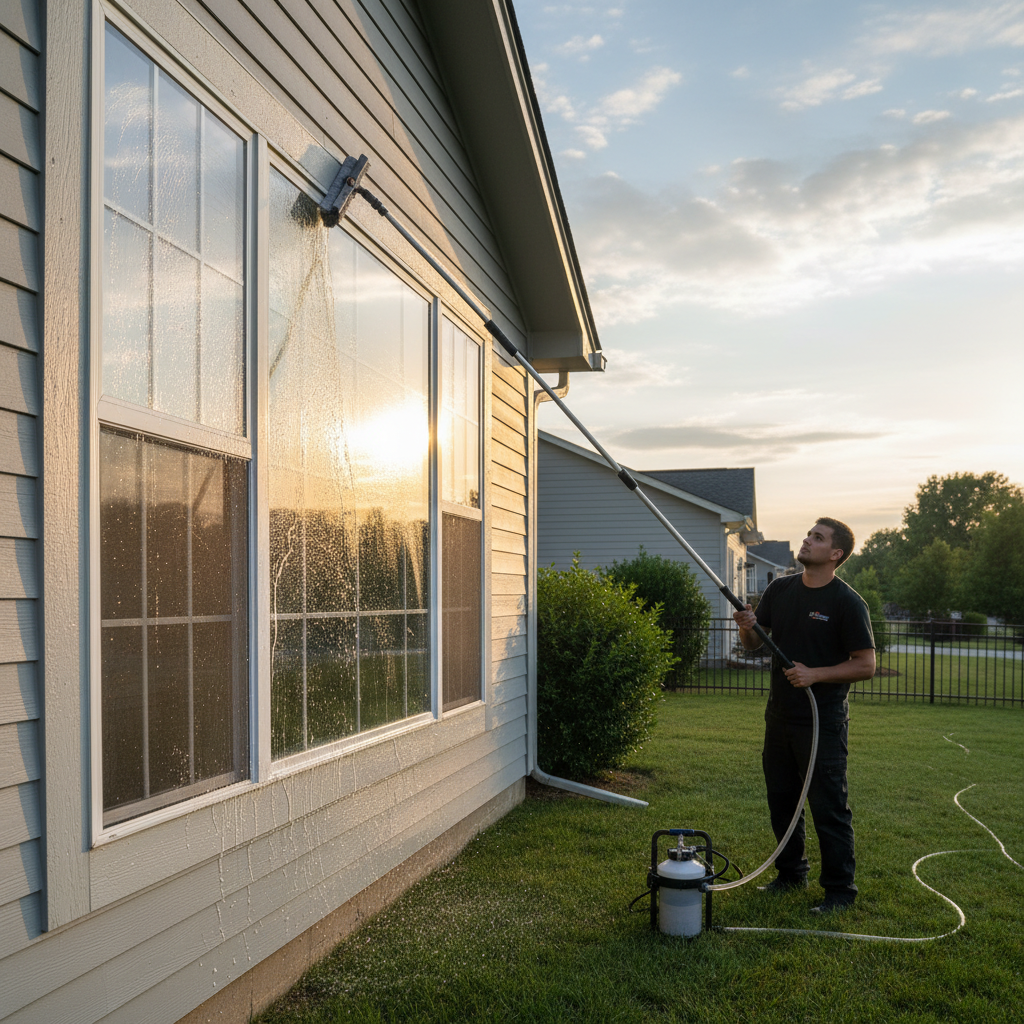
Method 4: Water‑Fed Pole (Upper Exterior Windows)
- Brush glass and frames with pure or low‑TDS water.
- Rinse thoroughly; allow to air‑dry spot‑free.
- Work from top windows down to prevent re‑wetting lower panes.
For ground‑level safety on taller exteriors, a water‑fed pole keeps your feet on the ground. On heavily soiled panes, pre‑wash with a light soap mix before the pure‑water rinse.

Step-by-Step: Our 7‑Step Streak‑Free System
Pre‑dust frames, wet evenly, squeegee with overlapping strokes, and detail edges immediately. Use two clean microfibers—one for drying, one for polishing. Work top to bottom, change cloths every 2–3 panes, and finish by inspecting from two angles under natural light.
- Prep the area: Lay a towel, open latches, and remove screens.
- Dust first: Brush frames and tracks so grit doesn’t scratch glass.
- Wet the pane: Apply a thin, even soap film with an applicator.
- Create a dry line: Squeegee the top edge horizontally.
- Pull strokes: Make smooth, vertical passes, overlapping 1 inch.
- Detail: Dry edges and corners with a clean, dry microfiber.
- Quality check: Tilt your head; inspect from two light angles.
For picture windows, switch to a wider 14–18 inch squeegee and slow your pull slightly to maintain full blade contact. If you see faint arcs, check for a nicked rubber or heavy hand pressure.
Tools and Supplies That Make the Difference
A sharp squeegee, two high‑pile microfiber cloths, a sleeve applicator, and a small bucket are the essentials. Distilled water helps in hard‑water areas. Skip paper towels and overly strong detergents—they cause lint and residue that lead to streaks.
- Squeegee (10–14 in.): Everyday residential panes
- Wide squeegee (14–18 in.): Picture windows and sliders
- Applicator sleeve + handle: Even wetting without drips
- 2–4 microfiber cloths: Separate for drying vs. polishing
- Bucket (2–3 gal): Small volume keeps solution fresh
- Gentle dish soap: 1–2 drops per gallon
- Distilled water: Use when tap water spots
- Extension pole: Safer reach for tall interior panes
| Method | Best For | Pros | Watch‑outs |
|---|---|---|---|
| Squeegee + Microfiber | Most windows | Fast, consistent, low residue | Needs blade in good condition |
| Microfiber‑Only | Quick indoor spots | No drips, low setup | Not for heavy soil |
| Spray‑and‑Wipe | Mirrors, small panes | Convenient, precise | Overspray can streak |
| Water‑Fed Pole | Upper exteriors | Ground‑safe, spot‑free with pure water | Requires pure/low‑TDS water |
If you’d like an overview of professional window cleaning methods used by local pros, this window cleaning service guide explains common approaches and when to apply them.
Seasonal and Local Tips for Saskatoon Conditions
Plan exterior cleaning for mild days, switch to distilled water during hard‑water stretches, and reduce soap in dry, dusty weeks. In winter, clean interiors with minimal solution and warm microfibers to avoid fogging and slow dry times.
Saskatoon’s climate swings call for a few adjustments:
- Cold snaps: Use lukewarm water indoors, wring cloths nearly dry, and work smaller sections so nothing freezes on contact.
- Prairie dust and pollen: Pre‑rinse exteriors with a hose before soaping to keep grit from dragging across glass.
- Hard‑water weeks: Swap to distilled water for final wipes to head off spotting.
Local considerations for Saskatoon
- Schedule exterior glass for late morning or early afternoon on calm days to avoid wind‑blown dust resettling on wet panes.
- During late fall and early spring, add gutter and downspout checks—overflow carries dirty water onto freshly cleaned windows.
- For apartment and condo residents, prioritize safe interior cleaning and consider professional help for exterior panes that require special access.
If you’re planning seasonal upkeep, pairing window and gutter care is smart; as a reference point, see this brief overview of gutter cleaning basics that often tie into pristine exterior glass.
Safety Essentials for Homeowners
Favor ground‑based tools first. If you must use a ladder, keep a 4:1 angle, maintain three points of contact, and never overreach past your belt buckle. Avoid power lines, wet decks, and unstable surfaces. When in doubt, hire a pro for upper windows.
We prioritize safety on every Saskatoon job. Here’s what that looks like for DIY:
- Ground first: Extension poles and interior reach tools eliminate many ladder needs.
- Ladder angle: Base set 1 foot out for every 4 feet of height.
- Contact points: Two feet and one hand, minimum, at all times.
- Footing: Never place on ice, gravel, or soft soil; test for movement.
- Weather watch: Skip windy days for exterior upper panes.
- Helpers: A spotter keeps the base stable and hands tools up safely.
Common Streak‑Causing Mistakes (and Easy Fixes)
The usual suspects are too much soap, a dull squeegee edge, dirty towels, and skipping edge‑drying. Use a light soap mix, replace rubber regularly, keep a dedicated dry microfiber for edges, and overlap every stroke by 1 inch.
- Soap overload: Add only 1–2 drops per gallon.
- Worn rubber: Replace the squeegee edge when you see trails.
- Dirty cloths: Switch cloths every 2–3 panes; launder without fabric softener.
- Skipping the top dry line: Always create a dry border first.
- Rushing edges: Spend 5–10 seconds on gaskets and corners.
- Hot sun passes: Direct sun dries solution mid‑stroke—work in shade when possible.
Troubleshooting: Diagnose the Streak and Fix It Fast
Identify the streak pattern, then target the cause. Arcs point to a nicked rubber; vertical lines suggest missed overlap; rainbow sheen signals soap residue. Swap rubber, overlap 1 inch, reduce soap, and finish with a dry microfiber on edges and corners.
- Faint arcs or half‑moons: Inspect and replace the squeegee rubber.
- Vertical ribbons: Increase stroke overlap to 1 inch.
- Cloudy or rainbow sheen: Rinse and use less soap.
- Bottom drip lines: Dry the bottom gasket thoroughly.
- Spotting after dry: Switch to distilled or low‑TDS rinse water.
- Lint specks: Retire paper towels; use lint‑free microfiber only.
Mini Case Examples From Saskatoon Homes
Apartments often need interior‑only care with microfiber and a compact squeegee. Busy family homes benefit from a full squeegee system and monthly touch‑ups. Between‑tenant rentals pair deep track cleaning with pure‑water exterior rinses for fast, market‑ready shine.
- Condo interior refresh: We tackled fingerprints and cooking film using microfiber‑only on interior panes, then scheduled exterior access with building management.
- Family home, pets + kids: Full squeegee method indoors; we left two labeled microfibers so the family could spot‑clean nose prints in seconds.
- Between‑tenant rental: Deep‑cleaned tracks and screens, then used a water‑fed pole on exteriors to speed turn‑around before photos and showings.
Best Practices We Use on Every Job
Use the least aggressive method that achieves full soil removal, protect floors and sills, and finish with a two‑angle inspection. Keep tools clean, replace rubber regularly, and label microfibers by task to avoid cross‑contamination.
- Protect surfaces: Towels under sills; keep solution off wood.
- Fresh solution: Small bucket, refreshed every 6–8 panes.
- Blade care: Wipe rubber between each stroke.
- Cloth labeling: “Drying” vs. “Polishing” to stay consistent.
- Light test: Inspect from two angles before calling it done.
Need a hand? If you’d rather spend weekends with family, HAARSH KLEAN offers streak‑free window cleaning alongside our daily, weekly, and deep‑clean services—always with the same trusted cleaner, flexible evenings/weekends, and a make‑it‑right guarantee.
Frequently Asked Questions
These concise answers cover the top DIY questions about streak‑free window cleaning—ratios, timing, tools, and quick fixes—so you can get professional‑looking results without trial and error.
What is the best soap‑to‑water ratio for streak‑free windows?
Use 1–2 drops of gentle dish soap per gallon of lukewarm water. Too much soap leaves a film that creates rainbow sheen. If your tap water spots, make the final wipe with distilled water.
Should I clean windows in direct sunlight?
Avoid direct sun when possible. Heat speeds evaporation and can leave drying lines mid‑stroke. Work in shade or during cooler hours, and reduce solution volume so passes stay controllable.
How often should residential windows be cleaned?
For most homes, plan interiors every 2–3 months and exteriors 2–4 times a year. High‑touch areas with pets and kids may need quick microfiber touch‑ups weekly between full cleans.
What causes spots after my windows dry?
Spots usually come from minerals in tap water. Switch to distilled water for the final wipe, or rinse with a water‑fed pole that uses low‑TDS water to dry spot‑free.
Paper towels or microfiber—what’s better?
Use microfiber. Paper towels shed lint and can leave faint streaks. A clean, lint‑free microfiber absorbs the final film and buffs to a clear finish in seconds.
Conclusion: Clear Glass, Less Effort
Keep it simple: a light soap mix, a sharp squeegee, and clean microfibers. Work methodically from the top down, dry edges immediately, and adjust for Saskatoon’s seasons. With these habits, streak‑free windows become a fast, repeatable routine.
- Key takeaways:
- Use minimal soap and quality tools; replace rubber regularly.
- Overlap squeegee strokes and dry edges to prevent drip lines.
- Switch to distilled water when spotting persists.
- Time work around sun, wind, and seasonal dust.
Want it done for you? Book a convenient evening or weekend visit in Saskatoon and come home to spotless, streak‑free glass—backed by our 100% satisfaction promise.
HAARSH KLEAN
Need help keeping your home clean?
Book professional residential cleaning in Saskatoon and surrounding areas. Same cleaner, personal service, and a clean home you can actually enjoy.
Get Free Quote